Categories
Uncategorized

The Anatomy of an Airship

I have been writing Steam Punk for years. My hero has an airship and this article has been very interesting to me both to add realism to my story and just for historical interest. Of course, my heroes airship has giraffe nets…just in case.

Jodi L. Milner's avatarMy Literary Quest

Lately I’ve had a huge interest in steampunk and a huge part of steampunk is airships.  Today we shall learn all about the parts of an airship. It’s been a while since I’ve done a glossary post so here it is!
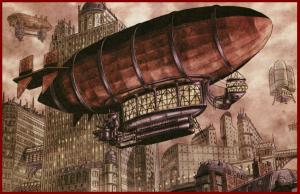
airship1 Steampunk Airship

First the three classes:

Rigid: This include ships like the Hindenburg and have an internal frame that holds a series of gas-filled bags. They are usually long and bullet shaped, often greater than 360 ft.

Semi-rigid: Instead of an internal frame, a semi-rigid airship uses a long metal keel that runs the length of the inside belly of the envelope.  The Norge Italia is a good example and if you look closely in the picture you can see where the keel is attached to the envelope.

Non-rigid: Now the most common modern airship, this class includes the blimps, like the Goodyear blimp. These are less expensive than…

View original post 424 more words

Categories
Medieval Marginalia Uncategorized

Hunting Noble Bunny Rabbit

Pontifical of Guillaume Durand, Avignon, before 1390 (Paris, Bibliothèque Sainte-Geneviève, ms. 143, fol. 165r)This is a fascinating image.  It shows a rabbit in the role of a noble.  He is riding with his hawk as any noble would but this is absurd.

First of all the noble is replaced with a rabbit.  Rabbits are an easy subject for anthropomorphic fantasies.  In the modern day, we can think of Brer Rabbit, Peter Rabbit and Buggs Bunny so I suspect this character, long lost in the midst of time, is of the same ken.

Just like Buggs Bunny and Peter Rabbit he has turned the tables on his hunter.  He is riding a hunting dog like a pony.  In this next image, the rabbit is thuming his nose, the classic insult from Shakespeare’s Romeo and Juliet at a dog hanging from a tree.  Clearly, the Medievals enjoyed as much as we do the reversal of fortune between the hunter and hunted.  Remember the black humour of those poachers being eaten by lions.

Unknown-13.jpeg

I suspect that the rabbit heroes were also representative of the class struggles of the Medieval town in the same way that Raynard the Fox represented the struggles of a good man living in an evil time.  The black pleasure of the evil henchman being tricked into a difficult situation by his greed.

The absurdity of the image is completed by the hawk.  Complete with glove the rabbit is going hawking with a snail.  The speed, grace, and beauty of the falcon replaced by the slimy, slow and clumsy earthbound snail.


Categories
Uncategorized

In Defence of the Liberal Arse,​ I mean Arts! Arts! In defense​ of the Liberal Arts

images-4.jpegimage.png

I think anyone involved in the Humanities is haunted by that suspicion that the Liberal Arts need defending and sometimes the case seems hard to make.  Did the Liberal Arts cure disease? No.  Did the Liberal Arts build suspension bridges and get us to the moon?  No.  Did they help defeat Hitler?  Kinda but I expect the application of science contributed as well.

The point is that sometimes you are faced with some rich man in a pub who asks you what you do and when you say, “I am a historian” he replies “How do you make money?” Well, I believe in the value of the liberal arts and you can make money out of it.

A prime example is Monty Python and the Search for the Holy Grail.  The animation is one of the strongest elements of the film and as you can see there is a direct inspiration for the classic “bottom trumpet” in marginalia.  From this and other films, the Pythons created a career and a lasting cultural phenomenon.

So if you have a gift for history or any other of the liberal arts go for it.  Get good at it and maybe you can be inspired by the past to create something for the funny.  And there is not much funnier than “bottom trumpets”. Maybe the catsnail?


Categories
Uncategorized

Trajan’​s Column

I’ve been posting about Trojans Column and illuminating it with some interesting images.  These images are a record of the freise at Lunt Roman Fort.  They are no longer on display so I am pleased to have the opportunity to put them on display here.image

OLYMPUS DIGITAL CAMERA
Categories
Uncategorized

Medieval Marginalia: Confounding Prejudice about Medievals

I have been posting a lot about marginalia for two reasons; first I love it and second, there is so much of it.  Marginalia is literally drawn or written in the margins of a book or text.  I do it to make notes or to express my discontent when I disagree with an author.  Sometimes it is very interesting to see what other people write in books.  I know that there is a book entirely about Ayn Rands marginalia.  There is a medieval scholar of whom we have none of his books but we do have his marginalia and from that, we can see that he was incredibly well read, I’ve forgotten his name but am sure I will be able to find it again.

Unknown-2.jpeg

I have an interest in the images in medieval books.  Above we can see an image of a joust.  A rabbit is carrying a dog whilst another rabbit rides a snail, on a spiky twig.  Now if someone tells you they know what this means I am sorry to say they are at best guessing.

images-1

And now I am going to join in with the guessing.   A few facts are clear.  First, these cost money.  The ink and the parchment were expensive, I assume.  As I write this I remember that I am not a medieval scholar and I assume that these were expensive commodities but maybe they weren’t.  Even if they were prohibitively expensive maybe the medievals thought that it was wicked to waste parchment that wasn’t written on and that is why they filled up the gaps!  A bit like a gothic cathedral covered in gargoyles.  I’ve been looking at St Michael’s in Coventry today and that is crawling with gargoyles.  Some are religious and others are … secular.

image

I think that there are two mistakes to make about the medievals.  The first is to assume that all their art had secret meanings and second that they were deadly serious all the time.  If we assume that the marginalia was intended to use up blank space then you need a lot of images without being repetitive.  I suggest that this is why we see creative images.  I suggest that when the medievals had to come up with images they used their imaginations and came up with the kinds of scenarios you would find in loony tunes.

I think this puts to bed the idea that the medievals were a dour lot who spent all their time in the mud dying of plague.  Clearly, medieval Europe was a very colourful place and that colour came out of their minds.


Categories
Uncategorized

Medieval Marginalia; The great Snail threat! (Video)

Categories
Classics Roman Army

Scenes from Trajans Column

Categories
Roman Army

Roman Army At War

In this image we see the Roman Army engaged in a battle (to the left).  As the heavy infantry engage the Dacians the Emperor “interviews” a prisoner held before him by an auxiliary soldier.  The legion was for the battle winning action whilst the role of the auxiliary was to enable them to win.  Behind the emperor are the signum the standard and the cultic musicians.

p1010132.jpg

What is especially exciting is the mounted catapulta in the background. Mounted on a cart this Scorpion is a dart throwing artillery weapon that could be quickly and easily moved over the battlefield supporting the role of the infantry.

The success of the Roman Army lies not only in the fantastic equipment and training of the legion but in the backup it received from the rest of the army.  In modern terms this can best be described as the “warm fuzzy” feeling that the British Army tries to inspire.  The idea that the individual soldier is not alone and everyone else has his back.  Consider this, if you had this feeling how could you not conquer the world?

Categories
prehistory

The Merry Maidens,Cornwall

I took this photograph in 2015. IMG_0837.JPG

Categories
Classics Roman Army Uncategorized

Cultic Behaviour in the Roman Army; Head Hunting

This is one of the fascinating scenes from Trajans Column in Rome.  It shows an Auxillary soldier holding a head in his mouth.  What it suggests is that he is a celt, possibly from Britain, Gaul or Spain who has been recruited into the army and is now fighting in Dacia.

p1010052.jpg