Categories
church crawling

The Old Cathedral of St Michaels, Coventry

Coventry is blessed with cathedrals (Cathedra?) in that it has three of them. Of the first only a few ruins remain and of the third it stands but the third remains a ruin in memory of the Coventry Blitz of November 1940.
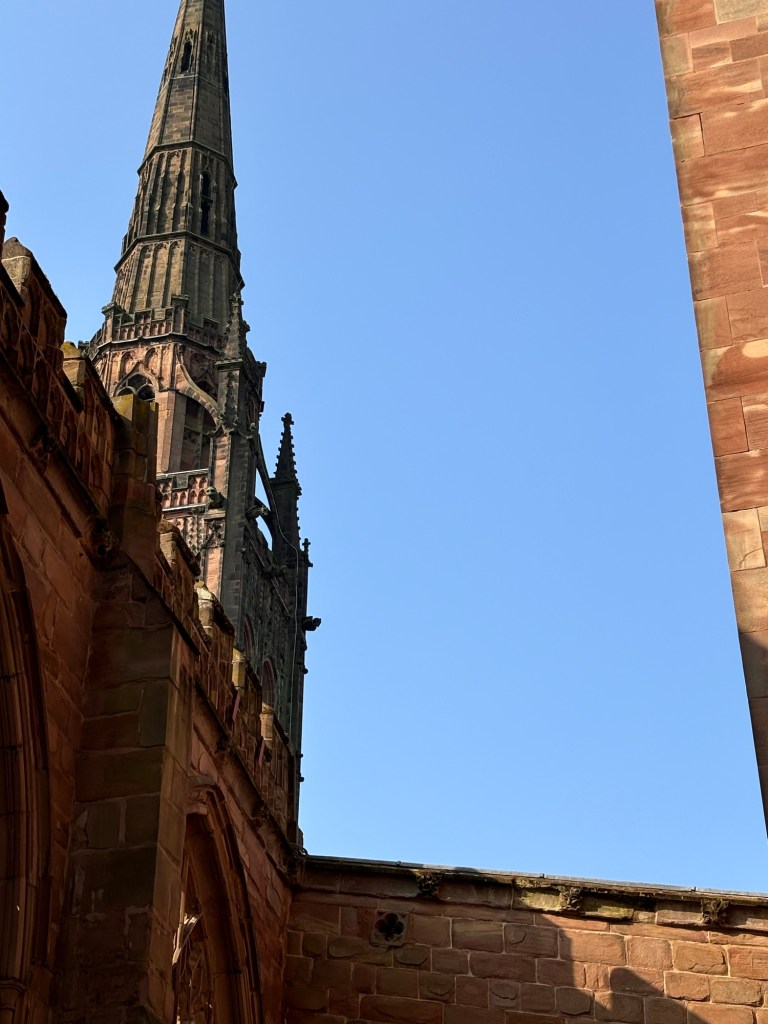
St Michaels was built in the between the 14th and 15th centuries in impressive red sandstone. The spire is the third highest in England and the choir sat on meisercords showing the famous Dance of Death. Nothing remains of these carvings beyond an account held by the city archives. It was an impressive Gothic church covered in carvings with wonderful stained glass windows. It was raised to Cathedral status in 1918 and served in that capacity till its destruction in the 1940s.

In 1940 it was destroyed during the Coventry Blitz by incendiary bombs. In an act of defiance against the Nazi hate Provest Richard Howard had the words “Father Forgive” inscribed behind the alter and used his Christmas address (Christmas Underfire), broadcast which was recorded in the bombed out ruins, to the world, to call for peace and reconciliation.
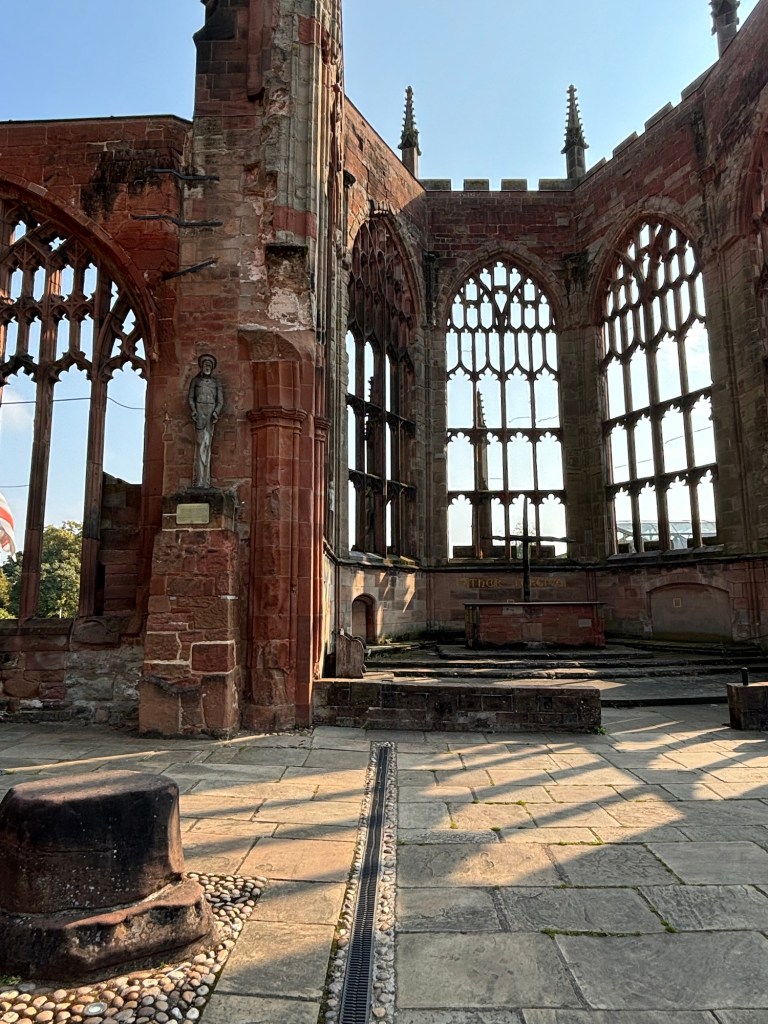
Housed in the ruins are the Coventry Blitz museum which I regard as one of the two second best museums in Coventry. A wonderful collection in an intimate space, well worth a visit.

The ruins of the Cathedral are a meditative and reflective space remaining holy ground and a national monument not to war or reprisal but to reconciliation and peace. If you’re visiting Coventry the Cathedral ruins are well worth a trip.

Categories
church crawling

Doom Painting, Holy Trinity Coventry

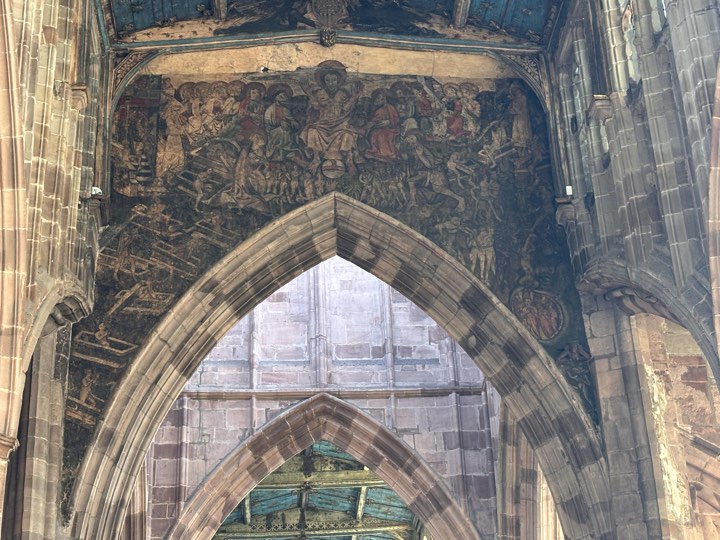
Inside Holy Trinity church in the city centre of Coventry is an impressive Medieval Doom painting. Now, I think that Coventry first should be embarrassed by the amount and quality of Medieval remains there are so many and they are so impressive! The city is crawling with Green Men, wood woses and blood curdling gargoyles but Holy Trinity stands out as a church with everything.

The Doom painting is probably about three hundred years old and was ironically preserved by reformers who painted over it in white wash. It was rediscovered in the Victorian era and restored in the 1990s by specialist restorers who have made this wonderful example of Medieval art accessible for us today. It is moments like this that I live for. I love seeing things that people throughout the past have seen. This links us back to our ancestors who came to this church to practice their religion and be awed by the structure. Imagine living in a one story house outside Coventry in one of the villages. On market day coming into the city, trading, being entertained and then entering Holy Trinity. It is a huge structure made of stone and in the Medieval period reverberating to sung masses. The walls would not be bare but painted and like me, I imagine them staring at the dramatic Doom painting.

The Holy Trinity Doom painting is one of sixty known to exist in the country. It is an allegory of the last day known as Dooms day. This painting shows Christ front and centre, surrounded by the Apostles, raising his pierced hands in judgment, note the book of evidence and the orb symbolising Christs kingship over the world and over the living and the dead. The dead are being raised from their tombs in the left hand corner from which like the living they will have to give an account for their lives. Featured are two scrolls which issue an invitation to the righteous “Come you blessed of my Father” and a command to the damned “Depart from me, you who are cursed, into eternal fire!” Leading the redeemed into heaven is the Pope who enters by the door beside St Peter and Christ whilst Mary the virgin mother of Christ presents a scroll and bears her breast in intercession for the damned. These damned can be seen on the right hand side in chains being led to hells mouth. Some are already there, being licked by flames whilst a group of wealthy women carrying ale jugs are wandering oblivious to the danger hand in hand with the devils to hell.

This gem of the Medieval world can be seen in Holy Trinity Church which opens on a Saturday at 11am. Other sights of interest include a fabulous collection of Meisercords, Green Men and Victorian paintings. Well worth a visit and the evening service is sublime.

Categories
Uncategorized

An odd old story about the Old Grammar School

As you all know I am a historian. Part of this involves going to archives and researching. Long before the pandemic I was interested in the Black Death in Coventry.

So I went to the Coventry archives to see what documents they held and discovered that others had done the work for me. The documents relating to the Black Death were well known and commented on.

One set really caught my eye. They were legal documents from 1347 detailing two cases. The first was squatters in houses rented by Eleanor of Aquitaine (yes her, she lived in Coventry) who refused to pay their rent. The second related to the Master of the Hospital (yes those Knights) which was housed in the building where the Old Grammar School is now. One day the Master had been bringing supplies into the city when he was accosted by Richard Prior of the Cathedral and certain Council members who assaulted the Master and stole his supplies.

Categories
Uncategorized

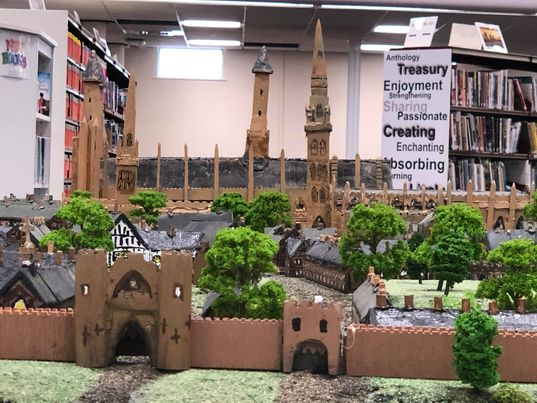
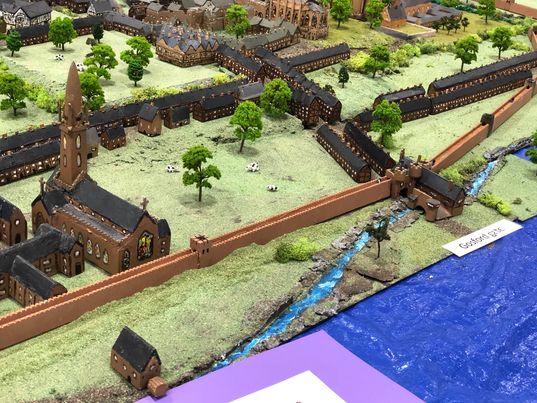
Lock Down Project Model: Coventry

This fantastic model was created during the first lock down of 2020 by an incredibly talented Coventry resident. I saw it at Coventry Central Library but it is now on display in the Frier Gate building.

Categories
Medieval Marginalia Uncategorized

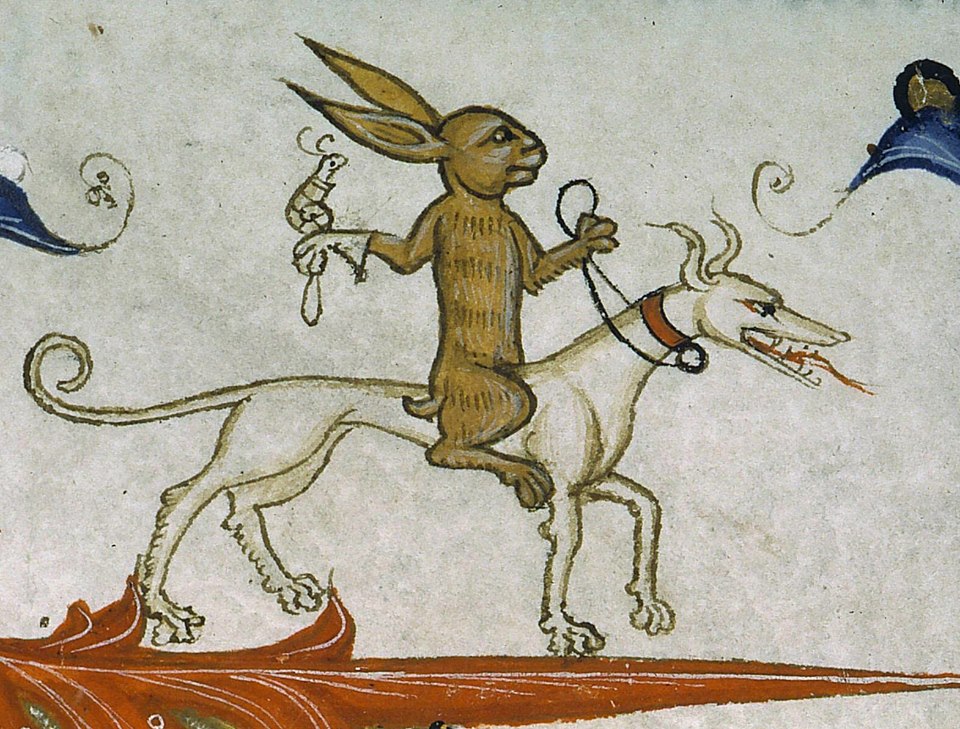
Hunting Noble Bunny Rabbit

Pontifical of Guillaume Durand, Avignon, before 1390 (Paris, Bibliothèque Sainte-Geneviève, ms. 143, fol. 165r)This is a fascinating image.  It shows a rabbit in the role of a noble.  He is riding with his hawk as any noble would but this is absurd.
First of all the noble is replaced with a rabbit.  Rabbits are an easy subject for anthropomorphic fantasies.  In the modern day, we can think of Brer Rabbit, Peter Rabbit and Buggs Bunny so I suspect this character, long lost in the midst of time, is of the same ken.

Just like Buggs Bunny and Peter Rabbit he has turned the tables on his hunter.  He is riding a hunting dog like a pony.  In this next image, the rabbit is thuming his nose, the classic insult from Shakespeare’s Romeo and Juliet at a dog hanging from a tree.  Clearly, the Medievals enjoyed as much as we do the reversal of fortune between the hunter and hunted.  Remember the black humour of those poachers being eaten by lions.

Unknown-13.jpeg

I suspect that the rabbit heroes were also representative of the class struggles of the Medieval town in the same way that Raynard the Fox represented the struggles of a good man living in an evil time.  The black pleasure of the evil henchman being tricked into a difficult situation by his greed.

The absurdity of the image is completed by the hawk.  Complete with glove the rabbit is going hawking with a snail.  The speed, grace, and beauty of the falcon replaced by the slimy, slow and clumsy earthbound snail.


Categories
Uncategorized

Ancient Games: Kings Table and Fox and Geese

There is no game like an old game.  Fox and Geese is a Medieval game which fell out of favour in the Tudor period but still holds its own as a board game today.  What is exciting about both these games is that they are asymmetric.  One Fox against sixteen geese.  The Geese want to trap the fox so that it can not move and the fox takes the geese by jumping over them like in Checkers.  What it amount to is an exercise in concentration.  The geese have to advance without allowing the individuals to become isolated where they are vulnerable to the fox.  The fox in contrast must be mobile and look for those opportunities to spoil the geese players day.

My wife bought me a copy one Christmas having seen my copy of Kings Table which is another really good game.  I mostly play against my Father with this lovely set.  The board is printed cloth and the pieces are resin copies a real Viking chess set now in the British Museum.  Again this is a asymmetric  game   of white against red.  The white player wants the King piece to escape.   It does so by  getting to a corner .  The red player is seeking to trap the King  so he can not move.  In the Viking period  they played a variety of board which ranged from  small representing a bar brawl, medium (this size)  which represents a small engagement or ambush and incredibly large which could represent an entire campaign.

These games make excellent Christmas presents.  They are delightfully made and deeply engaging.  I have had both my sets for over ten years and am always up for a game.

Categories
Uncategorized

Medieval Marginalia anti social rabbits